HYPERSTRUCTURES AS TOOL TO COMPARE URBAN PROJECTS
Keywords:
Hyperstructures, Fuzzy sets, Evaluation of urban projects, Multicriteria programming techniqueAbstract
The objective of this work is the application of theories of fuzzy sets and hyperstructures to the problem of selection among alternative urban projects, so to identify those ones pursue a predetermined set of heterogeneous objectives in the best way. The recourse to fuzzy sets depends on the consciousness that all the planning stages are in condition of uncertainty. So it is necessary to adopt techniques that permit to study the uncertainty about the influence that a decision could have on the validity of the project. The hyperstructures, instead, in this case represent a way to define sonic rules to chooseReferences
Corsini P., Prolegomena of hypergroup theory, Aviani Ed. Udine, (1993).
Ferri B, Maturo A., Uri rnodello mater atico per la valutazione di fattibilite dei programmi integrari di intervento urbana, in "Ratio Mathernalica" 10, 1996, pp.67-84.
Ferri B, Maturo A,, Confront° _Pa proposte di intervento urbano utilizzando la teoria dei fuzzy set, in Atti del Convegno Nazionale "1 fondarnenti della matematica ed i suoi legami con la societa. contemporanea", Verona, 28-30 novembre 1996, pp,407-418.
Ferri B, Maturo A., Fuzzy classification and hyperstructures: an application to evaluation of urban projects, in "Book of Short Papers" of the Scientific Reunion Scientific IFCS, Pescara, 3-4 luglio 1997, pp.137-140.
Maturo A., On some hyperstructures of conditional events, in Proceedings of sixth International Congress on Algebraic Hyperstructures and Applications, pp.115-132, Prague, Czech Republic, September 1-9, 1996.
Migliorato R., Some topics on the feebly associative hypergroupoids, in Proceedings of the fifth International Congress on Algebraic Hyperstructures and Applications, pp.67-80, Iasi, Rumania, 1993.
Prenowitz W., Jantosciak J0111 Geometries, Springer-Verlag UTM, New York, (1979).
Vougiouklis T., Hyperstructures and their representations, Hadronic Press, (1994).
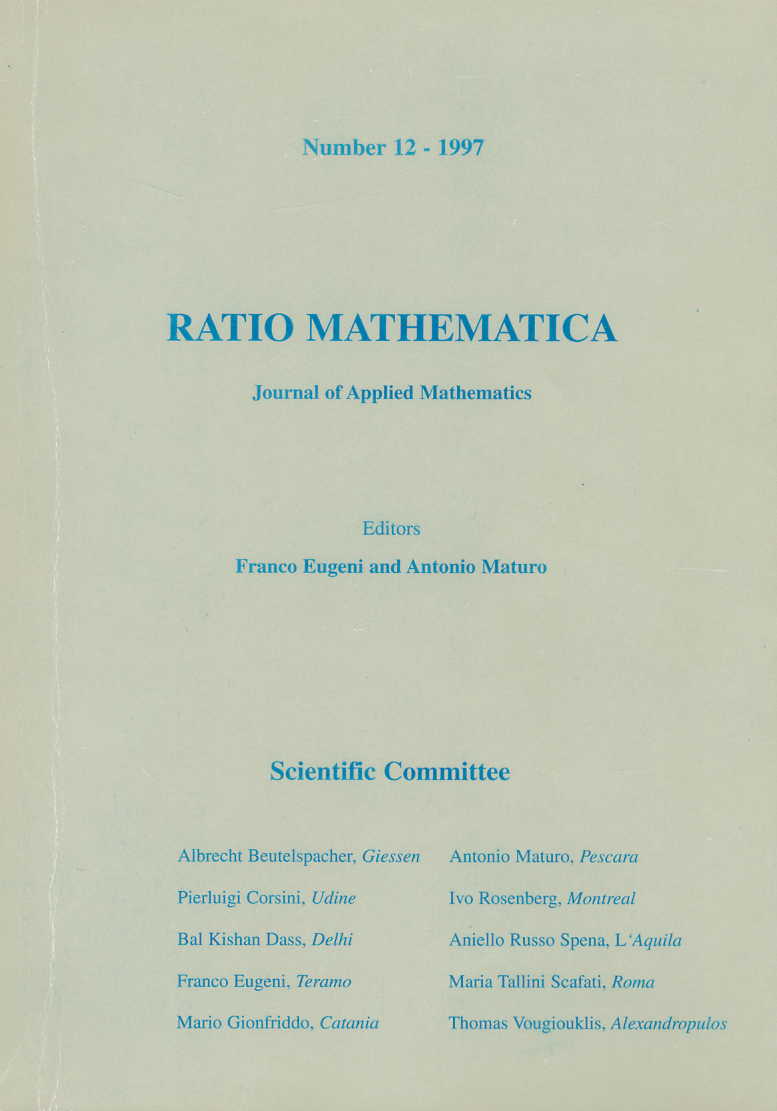
Downloads
Published
Issue
Section
License
This journal provides immediate open access to its content on the principle that making research freely available to the public supports a greater global exchange of knowledge. The journal is committed to real and immediate open access for academic work. All of the journal articles are free to access immediately from the date of publication. There are no charge for readers to download articles and reviews for their own scholarly use. Benefits of open access for authors, include:
- Free access for all users worldwide
- Increased visibility and readership
- Rapid publication
- No spatial constraints
- Authors can share their research papers on their personal web-pages (i.e. ResearchGate, etc.)
Ratio Mathematica publishes open access articles under the terms of the Creative Commons Attribution (CC BY) License. The Creative Commons Attribution License (CC-BY) allows users to copy, distribute and transmit an article, adapt the article and make commercial use of the article. The CC BY license permits commercial and non-commercial re-use of an open access article, as long as the author is properly attributed. Copyright on any research article published by Ratio Mathematica is retained by the author(s). Authors grant Ratio Mathematica a license to publish the article and identify itself as the original publisher. Authors also grant any third party the right to use the article freely as long as its original authors, citation details and publisher are identified.
For further information visit: https://creativecommons.org/licenses/by/3.0/. The following logo will appear in any paper that will be published from the volume number 31/2016 onwards.
