En Route for the Calculus of Variations
DOI:
https://doi.org/10.23755/rm.v36i1.467Keywords:
Calculus of variations, Johann Bernoulli, Jacob Bernoulli, Euler, Lagrange, Maupertuis, principle of least actionAbstract
Optimal control deals with the problem of finding a control law for a given system such that a certain optimality criterion is achieved. An optimal control is an extension of the calculus of variations. It is a mathematical optimization method for deriving control policies. The calculus of variations is concerned with the extrema of functionals. The different approaches tried out in its solution may be considered, in a more or less direct way, as the starting point for new theories. While the true “mathematical” demonstration involves what we now call the calculus of variations, a theory for which Euler and then Lagrange established the foundations, the solution which Johann Bernoulli originally produced, obtained with the help analogy with the law of refraction on optics, was empirical. A similar analogy between optics and mechanics reappears when Hamilton applied the principle of least action in mechanics which Maupertuis justified in the first instance, on the basis of the laws of optics.
References
Bernoulli, J. Opera Omnia. Lausanne and Geneva, 1742.
Chabert, J.-L. The Brachistrone Problem. History of Mathematics, Histories of Problems, Elipse, Paris, 1997, pp. 183-202.
Euler, L. Methodus inveniendi lineas curvas maximi minimive proprietate gaudentes: sive solution problematic isoperimetrici lattissimo sensu accepti, Lausanne and Geneva, 1774 (Œvres, vol. 24, Berne, Orel Füssli, 1952).
Fermat, P. Œvres, ed. Tannery, P. and Henry, C., Gauthier-Villars, Paris, 1894.
Galileo, G. Discorsi e dimostrazioni matematiche intorno a duo nuove scienze, Leyden, 1638.
Lagrange, J.-L. Essai d’une nouvelle méthode pour déterminer les maxima et les minima des formules integrals defines. Miscellanea Taurinensia, vol II, 1760-1761 (Œvres, vol. I, Paris, pp. 333-468).
Mach, E. Die Mechanik in ihrer Entwickelung : historisch-kritisch dargestellt, F. A. Brockhaus, Leipzig, 1883.
Maupertius, P. L. M. de. Accord de différentes lois de la nature qui avaient jusqu'ici paru incompatibles. Mémoires de l’Acadenie des Sciences de Paris, 1744, pp. 417-426.
Maupertius, P. L. M. de. Les lois du movement et du repos déduites d’un principe métaphysique. Mémoires de l’Acadenie des Sciences de Berlin, 1746, pp. 267-294.
Newton, I. Correspondence, ed. by Scott, J. F., vol. IV (1694-1709), Cambridge University Press, Cambridge, 1967.
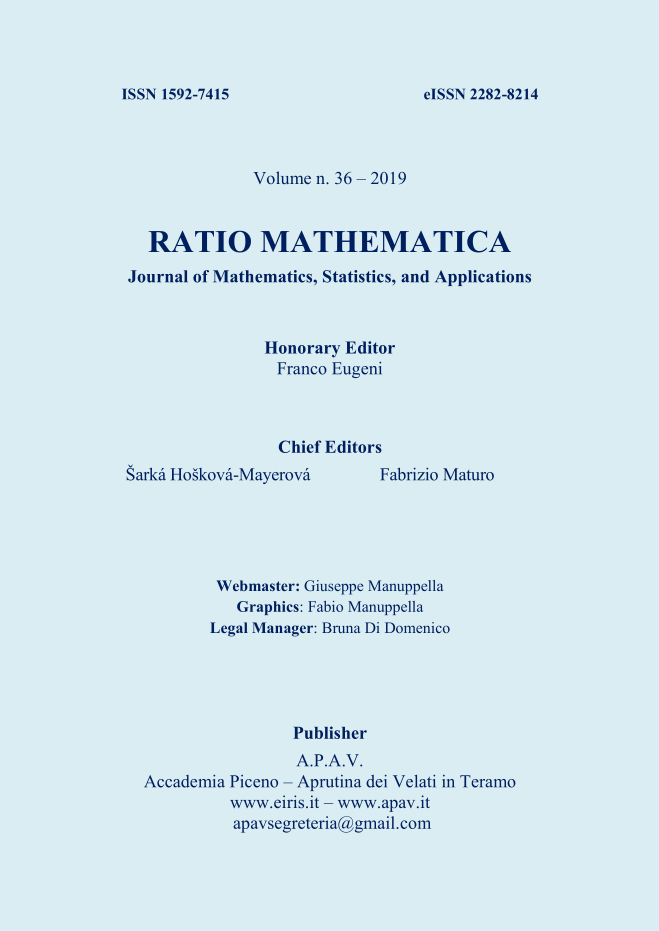
Downloads
Published
Issue
Section
License
This journal provides immediate open access to its content on the principle that making research freely available to the public supports a greater global exchange of knowledge. The journal is committed to real and immediate open access for academic work. All of the journal articles are free to access immediately from the date of publication. There are no charge for readers to download articles and reviews for their own scholarly use. Benefits of open access for authors, include:
- Free access for all users worldwide
- Increased visibility and readership
- Rapid publication
- No spatial constraints
- Authors can share their research papers on their personal web-pages (i.e. ResearchGate, etc.)
Ratio Mathematica publishes open access articles under the terms of the Creative Commons Attribution (CC BY) License. The Creative Commons Attribution License (CC-BY) allows users to copy, distribute and transmit an article, adapt the article and make commercial use of the article. The CC BY license permits commercial and non-commercial re-use of an open access article, as long as the author is properly attributed. Copyright on any research article published by Ratio Mathematica is retained by the author(s). Authors grant Ratio Mathematica a license to publish the article and identify itself as the original publisher. Authors also grant any third party the right to use the article freely as long as its original authors, citation details and publisher are identified.
For further information visit: https://creativecommons.org/licenses/by/3.0/. The following logo will appear in any paper that will be published from the volume number 31/2016 onwards.
