The incompleteness of the Schroedinger equation
DOI:
https://doi.org/10.23755/rm.v52i0.1606Keywords:
Nonlinear Schro ̈dinger equation, mass, Zeilinger con- stant, experiment.Abstract
The Schrodinger equation with the nonlinear term is derived in the framework of the Dirac heuristics. The particle behaves classically in case its mass is infinite. The nonlinear term is crucial and involves a new physical constant b which can be measured via the same meth- ods used for the Casimir effect and accurate experimental procedures. New experiments, different from the Zeilinger ones, are proposed with Faraday simplicity for the determination of the new very small value of the constant b.
References
Spaarnay, M. J.: Measurements of attractive forces between flat plates, Phys- ica 24, 751 (1958).
Tabor, D. and Winterton, R. M. S.: The direct measurement of normal and retarded van der Waals forces, Proc. Roy. Soc. A 312, 435 (1969).
Pardy, M.: To the nonlinear quantum mechanics, Fac. Sci. Nat. Univ. Masaryk, Brun. 23, Physics 114 (1993).
Pardy, M.: Possible Tests of Nonlinear Quantum Mechanics in: Waves and Particles in Light and Matter (Ed. by Alwyn van der Merwe and Augusto Garuccio, Plenum Press New York). 419-422 (1994).
Pardy, M.: To the nonlinear quantum mechanics, quant-ph/0111105 (2001).
Einstein, A., Podolsky, B. and Rosen, N.: Can Quantum Mechanical Descrip- tion of Physical Reality Be Considered Complete?, Physical Review 47, 777-780 (1935).
Schnabel, R.: The solution to the Einstein-Podolsky-Rosen paradox, arXiv: 2208.13831v3 [quant-ph] 26 Oct (2022).
Broglie de, L.: Non-linear Wave Mechanics, Elsevier, Amsterdam. (1960). [9] Bialynicky-Birula, I. and Mycielski, J.: Nonlinear Wave Mechanics, Ann. Phys. (N.Y.) 100, 62 (1976).
Shimony, A.: Proposed neutron interferometer test of some nonlinear variants of wave mechanics, Phys. Rev. A 20, No. 2, 394 (1979).
Shull, C. G., Atwood, D. K., Arthur, J. and Horne, M. A.: Search for a Non- linear Variant of the Schro ̈dinger Equation by Neutron Interferometry, Phys. Rev. Lett. 44, 765 (1980).
Ga ̈hler, R., Klein, A. G. and Zeilinger, A.: Neutron optical tests of nonlinear wave mechanics Phys. Rev. A 23, 1611 (1981).
Pais, A.: Playing with Equation, the Dirac Way, preprint RU/86/150, Rocke- feller University New York, quant-ph/0111105 (1986).
Madelung, E.: Quantum Theory in Hydrodynamical Form, Z. Physik 40, 322 (1926).
Bohm, D. and Vigier, J.: Model of the Causal Interpretation of Quantum The- ory in Terms of a Fluid with Irregular Fluctuations, Phys. Rev. 96, 208 (1954).
Wilhelm, E.: Hydrodynamic Model of Quantum Mechanics, Phys. Rev. D 1, 2278. (1970).
Rosen, N.: A classical picture of quantum mechanics, Nuovo Cimento 19 B, No. 1, 90 (1974).
Lemos, N. A.: Stochastic derivation of the Birula-Mycielski nonlinear wave equation Phys. Lett. 94A (1), 20 (1983).
Glauber, R. J.: Amplifiers, Attenuators and the Quantum Theory of Measure- ment, preprint of the Harvard Univ., Lyman Lab. of Physics. (1986).
Mo ̈ssbauer, R. L.: Kernresonanzfluoreszenz von Gammastrahlung in Ir191, Z. Phys. 151, 124 (1958).
Barut, A. O.: Quantum Theory of Single Events: Localized de Broglie wavelets, Schro ̈dinger Waves and Classical Trajectories, preprint ICTP Trieste IC/90/99, (1990).
Kamesberger,J.andZeilinger,A.:NumericalsolutionofanonlinearSchro ̈dinger equation for neutron optics experiments, Physica B + C, 151, 193 (1988).
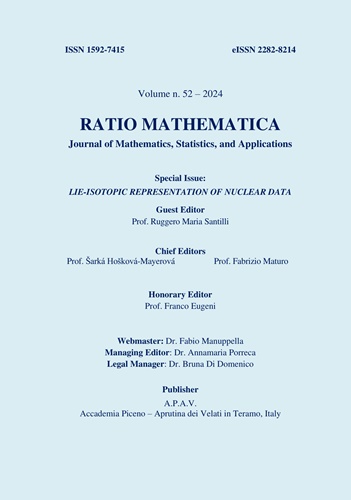
Downloads
Published
Issue
Section
License
This journal provides immediate open access to its content on the principle that making research freely available to the public supports a greater global exchange of knowledge. The journal is committed to real and immediate open access for academic work. All of the journal articles are free to access immediately from the date of publication. There are no charge for readers to download articles and reviews for their own scholarly use. Benefits of open access for authors, include:
- Free access for all users worldwide
- Increased visibility and readership
- Rapid publication
- No spatial constraints
- Authors can share their research papers on their personal web-pages (i.e. ResearchGate, etc.)
Ratio Mathematica publishes open access articles under the terms of the Creative Commons Attribution (CC BY) License. The Creative Commons Attribution License (CC-BY) allows users to copy, distribute and transmit an article, adapt the article and make commercial use of the article. The CC BY license permits commercial and non-commercial re-use of an open access article, as long as the author is properly attributed. Copyright on any research article published by Ratio Mathematica is retained by the author(s). Authors grant Ratio Mathematica a license to publish the article and identify itself as the original publisher. Authors also grant any third party the right to use the article freely as long as its original authors, citation details and publisher are identified.
For further information visit: https://creativecommons.org/licenses/by/3.0/. The following logo will appear in any paper that will be published from the volume number 31/2016 onwards.
