Attuali sviluppi nello studio dell’associazione tra variabili di tipo qualitativo.
Abstract
The most common procedure for analyzing contingency table data is by using chi-square statistic. The early development of chi-square analysis of contingency table is credited to Pearson (1904) and Fisher (1929), successively expanded by Yates, Mantel-Haenszcl etc. In this paper some developments of the chi-square function has been outlined, particularly as statistical test for the null hypothesis of independence, for subdividing contingency tables and the chi-square test for linear association between ordinal variables.
References
A.W. KIMBALL, Short-cut Formulas for the Exact Partitioning of chi square in Contingency Table, Biometrics 16, 1954.
P. ARMITAGE, Statistica medica, cd. Fellrinclli, Milano, 1992.
E. BALLATORI, Sui test statistici per il confronto tra due frequenze in
tabelle 2x2, Mclron, vol XL, 1982.
A. RIDOMI, Una formula genera/e per la scomposizione del 12, Statistica applicala, vol. 4 - mm}. 1992.
G. CHlSCl, Biometria principi e metodi, cd. Piccini, Padova, 1977.
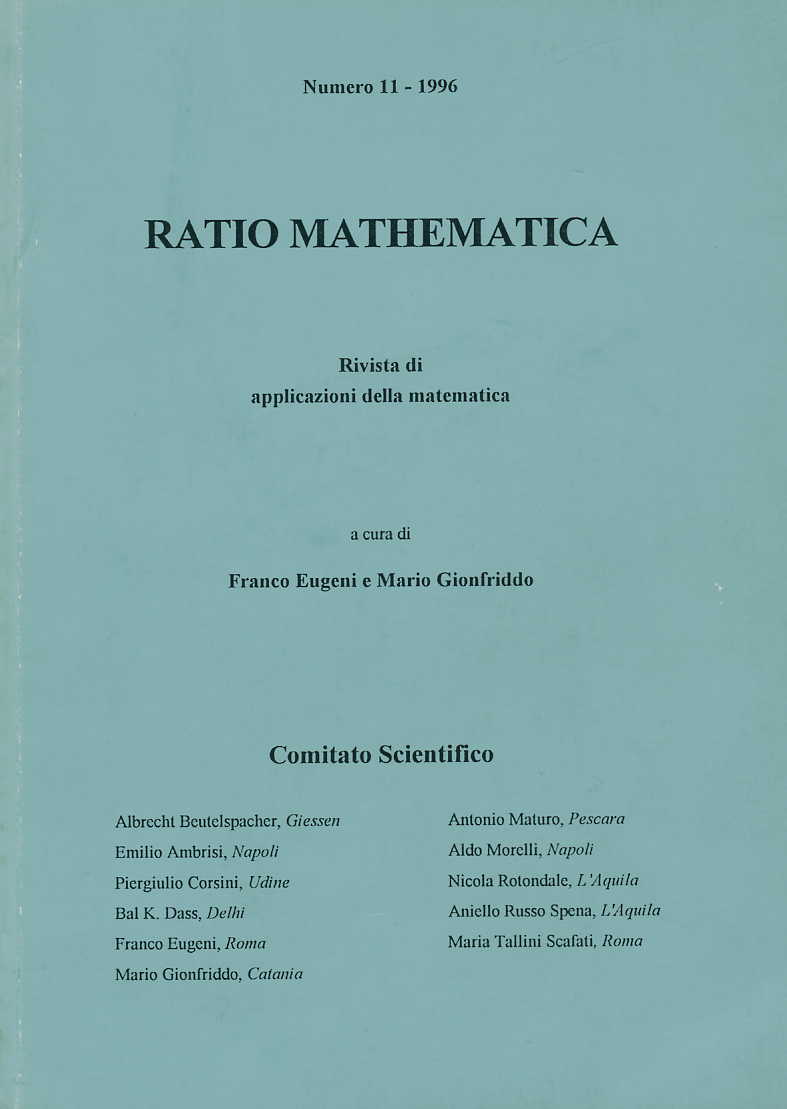
Downloads
Published
Issue
Section
License
This journal provides immediate open access to its content on the principle that making research freely available to the public supports a greater global exchange of knowledge. The journal is committed to real and immediate open access for academic work. All of the journal articles are free to access immediately from the date of publication. There are no charge for readers to download articles and reviews for their own scholarly use. Benefits of open access for authors, include:
- Free access for all users worldwide
- Increased visibility and readership
- Rapid publication
- No spatial constraints
- Authors can share their research papers on their personal web-pages (i.e. ResearchGate, etc.)
Ratio Mathematica publishes open access articles under the terms of the Creative Commons Attribution (CC BY) License. The Creative Commons Attribution License (CC-BY) allows users to copy, distribute and transmit an article, adapt the article and make commercial use of the article. The CC BY license permits commercial and non-commercial re-use of an open access article, as long as the author is properly attributed. Copyright on any research article published by Ratio Mathematica is retained by the author(s). Authors grant Ratio Mathematica a license to publish the article and identify itself as the original publisher. Authors also grant any third party the right to use the article freely as long as its original authors, citation details and publisher are identified.
For further information visit: https://creativecommons.org/licenses/by/3.0/. The following logo will appear in any paper that will be published from the volume number 31/2016 onwards.
